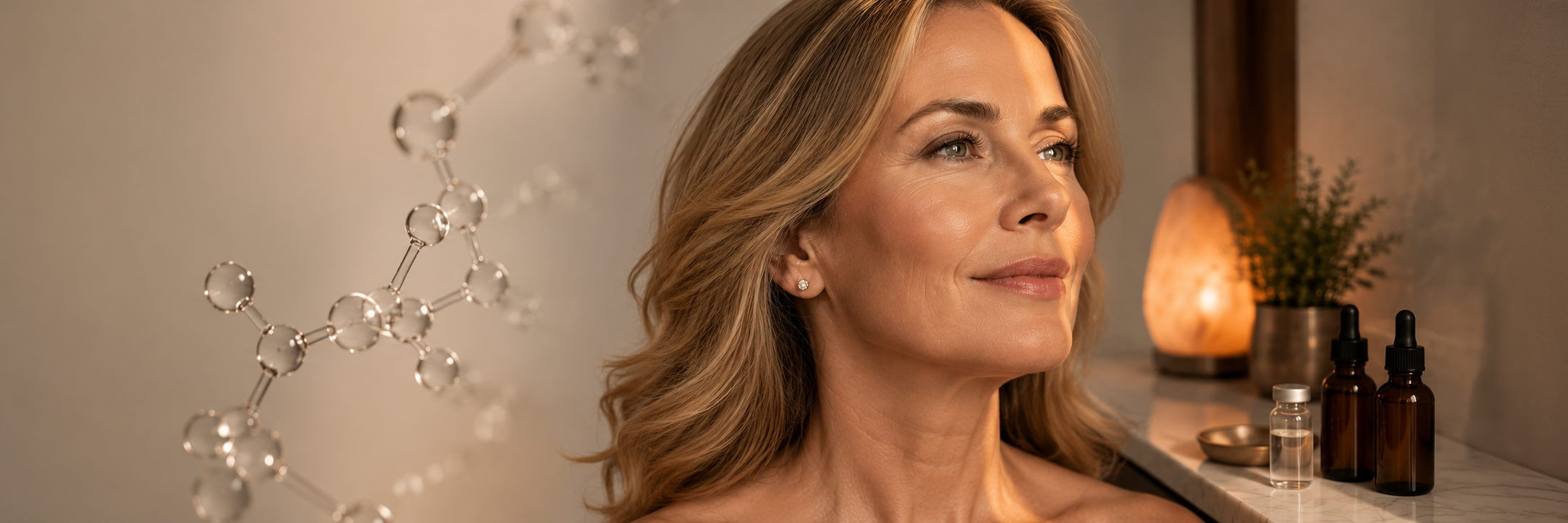
Peptides Are Everywhere Right Now. Here’s What You Actually Need to Know.
Peptides are having a cultural moment. They’re in the peptides skincare serums your dermatologist recommends, the wellness protocols your gym-going coworker is injecting, and the TikTok videos promising everything from collagen restoration to injury recovery. The word “peptide” has become shorthand for cutting-edge biological optimization — which makes it easy to forget that topical peptide serums and unregulated injectable peptides are not the same thing, not even close, and that confusing them can have real consequences.
This post is for anyone curious about peptides — what they actually are, what the research supports, and where the significant risks lie. We don’t offer injectable peptide therapy at Spa Noor, but we do carry medical-grade skincare with clinically validated peptide formulations, and we think the people we work with deserve accurate information about a category that is genuinely exciting in some ways and genuinely dangerous in others.
What Are Peptides, Actually?
Peptides are short chains of amino acids — the building blocks of proteins. Your body produces them naturally and uses them constantly. Collagen is a protein made of peptide chains. Insulin is a peptide. So are GLP-1 medications like Ozempic and Wegovy. In that sense, peptides are not exotic or experimental. They are fundamental to how biology works.
What’s driving the current trend is a different category: synthetic peptides engineered in labs to mimic or amplify specific biological signals. The idea is compelling. If your body uses peptides to communicate between cells — triggering collagen production, regulating growth hormones, stimulating repair — then could synthetic versions of those signals be used therapeutically? In some cases, yes. In many others, we genuinely don’t know yet.
The Good: Topical Peptides in Skincare
This is the most established and least controversial part of the peptide story. Topical peptides applied in skincare formulations have a reasonable body of clinical evidence behind them, and their safety profile is well understood.
The most studied include Matrixyl (palmitoyl pentapeptide-4), which signals fibroblasts to produce more collagen and has shown measurable improvement in fine lines in multiple clinical trials; Argireline (acetyl hexapeptide-3), which works similarly to Botox by inhibiting the neurotransmitters that cause repeated muscle contractions — though topically and with a much more modest effect; and copper peptides (GHK-Cu), which support wound healing, collagen synthesis, and have shown anti-inflammatory properties in topical applications.
A 2025 review published in PMC confirmed that topical peptides generally have favorable safety profiles, with adverse reactions limited to occasional mild tingling or temporary sensitivity, primarily in people with very dry or reactive skin. Because topical application results in low systemic absorption, the biological activity stays local and systemic side effects are unlikely.
The honest caveat: many over-the-counter products contain peptides at concentrations too low to produce measurable effects. The difference between a product that works and one that simply lists peptides on the label often comes down to formulation quality, concentration, and delivery technology. This is one of the reasons medical-grade skincare — formulated to pharmaceutical standards with clinically effective concentrations — outperforms most of what’s available at a drugstore or department store counter.
The Bad: The Injectable Peptide Gray Market
This is where the story gets more complicated — and more concerning.
Injectable peptides have exploded in popularity among biohackers, athletes, and wellness enthusiasts, fueled largely by social media influencers promoting compounds like BPC-157 (marketed for injury recovery and gut healing), TB-500 (muscle growth and inflammation), CJC-1295 (fat loss and sleep), and GHK-Cu (skin and hair repair). The claims are sweeping. The evidence is thin. And the regulatory landscape is, as one researcher put it, “the Wild Wild West.”
Here is what the FDA’s own position actually is: most peptides used in aesthetic and anti-aging practice are not FDA-approved drugs. They reach patients through compounding pharmacies, governed by the FDA’s 503A bulk drug substances list — which has three practical categories: under evaluation, identified as posing significant safety risks, and not nominated at all. In 2023, the FDA determined that 19 peptides posed significant safety risks and placed them on a de facto “do not compound” list.
The FDA’s Pharmacy Compounding Advisory Committee held a dedicated review of peptides as recently as July 2026. The assessment from one committee physician was direct: “It’s promising, and in 10 years we might say, ‘Hey, this stuff is great, what you’re giving is pure and safe.’ But right now, it’s just so unregulated that we just don’t know what these things really do in the human body.”
The American Medical Association has weighed in too. Physicians say patients should look past social media claims and marketing promises and start with a conversation with a doctor, because some injectable peptides are not regulated and may carry real health risks. Known side effects from the limited research available include nausea, diarrhea, increased heart rate, chest tightening, headache, elevated liver enzymes, and skin irritation at injection sites.
The Ugly: What Happens When It Goes Wrong
The risks of unregulated injectables are not theoretical. In 2025, two women were hospitalized after receiving peptide injections at an anti-aging conference in Las Vegas. Both experienced increased heart rate, trouble breathing, and swollen tongues. The pharmacy board was unable to determine exactly what the serums contained.
Unregulated peptides may be mislabelled, contaminated, or incorrectly dosed — a problem already documented in adjacent markets such as counterfeit steroids. Peptides that influence growth, repair, or hormonal pathways may also stimulate unintended processes, including potentially promoting the growth of existing tumors or disrupting normal endocrine function. This risk is amplified by the documented presence of heavy metals in illicit enhancement drug markets.
A consumer survey published in 2025 found that 65% of consumers incorrectly believe every website offering online prescription services has been reviewed or approved by regulators. Sellers exploit this misunderstanding deliberately, using scientific language, “research use only” disclaimers, and wellness marketing to appear credible. Reported adverse events from gray-market injectable peptides include unwanted skin pigmentation changes, infection, swelling, pain, redness, and new or changing moles.
It’s also worth noting: injectable peptides including TB-500 and BPC-157 are on the World Anti-Doping Agency’s list of banned substances and are banned by the U.S. military. If you’re an athlete or work in a regulated profession, this matters.
How to Think About Peptides in 2026
The distinction that matters most is not whether something is called a peptide. It’s what form it takes, where it came from, and whether it has been through genuine regulatory review.
FDA-approved peptide drugs — insulin, GLP-1 medications like semaglutide, and a handful of others — are among the most rigorously studied drugs available. Their manufacturing, dosing, and safety profiles are well understood. These are not the same thing as the BPC-157 someone bought from an overseas website and is injecting into their abdomen at home.
Topical peptides in medical-grade skincare formulations have a reasonable clinical foundation and a favorable safety profile. They are not a substitute for clinical treatments, but they are a legitimate part of a well-constructed skincare routine — particularly when the formulation is pharmaceutical-grade, properly concentrated, and paired with the right delivery technology.
Unregulated injectable peptides sold online, promoted on social media, or offered at wellness clinics without proper prescribing and oversight are a different category entirely. The promise is real enough to be compelling. The risk is real enough to warrant serious caution. Until the regulatory framework catches up with the trend, the most honest answer is: we don’t know enough yet, and injecting compounds of unknown purity into your bloodstream based on influencer recommendations is not a risk-benefit calculation most doctors would endorse.
What we use at Spa Noor
The skincare products we carry at Spa Noor — including formulations from Dermalogica, Environ, and our Spa Noor clinical line — include peptide-based formulations chosen for clinical evidence, pharmaceutical-grade concentration, and delivery technology that actually gets actives where they need to go. If you have questions about which peptide-based products make sense for your skin, ask at your next appointment. It’s a conversation worth having with people who understand the difference between a well-formulated serum and a wellness trend.
Questions About Your Skincare Routine?
Book a consultation at Spa Noor in Fall River, MA. We’ll talk through what your skin actually needs — and what the research actually supports. Serving New Bedford, Taunton, and the SouthCoast Massachusetts region.
Proudly serving Fall River, New Bedford, Taunton & the SouthCoast, MA